Applying for a job? You’ve probably heard the advice plenty of times (like here, here, and here) to tailor your resume for the position.
But, you might not know exactly how to put it into action. What does tailoring your resume involve? How many chances do you need to make? What content should you be focusing on?
It might sound like a lot of work, but it’s quite manageable. Here are a few ideas to get you started.
1. Read and Try to Understand the Job You’re Applying For
First things first: Sit down with a highlighter and read the job description. Go through and highlight the points that seem important (think the ones that are mentioned repeatedly or anything that’s slightly out of the ordinary) and the points that you could speak to with your experience and skills.
This always steps one—after all, you can’t tailor your resume for a position if you don’t know what the gig entails.
2. Make Your First Point Immediately Relevant
Next, with your newfound knowledge of what the hiring manager is looking for, take your resume, find the experience that would make him or her most excited about your application, and rework the document so that’s what’s at the top. Maybe it’s your current position, or maybe it’s some specialized certifications or the freelance work you do on the side. Whatever it is, make it the first section of your resume.
And yes, even if it’s not the most recent. No rule says your first section must be “Work Experience.” Tailoring your resume means finding what is most relevant, creating a section for it, and filling it up with experience or qualifications that will catch a hiring manager’s eye. If that means nixing “Work Experience,” creating a “Marketing and Social Media Experience” section, then throwing everything else in an “Additional Experience” section, then so be it.
3. Revamp Your Bullets Even for Less Relevant Experiences
Now that your relevant experiences are at the top of your resume, that doesn’t mean you should ignore everything else. Nope, it just means you need to pull out the relevant bits of those experiences in your bullets.
From the job description, you’ll likely find more than just the technical qualifications needed to complete the job. Strong communication skills, the ability to work in a team, and other soft skills are probably listed as well. So, while your tutoring experience might not be directly related to the sales position you’re interested in, you can still highlight some of the soft skills that both positions require. For some ideas on how to spin your bullets to emphasize certain soft skills, see this article: How to Spin 1 Resume Bullet 5 Different Ways
4. Check to See if It’s Clear Why You Are Applying
Finally, your last quick assessment to make sure you’ve successfully tailored your resume is to see if someone else—like a friend or mentor—can explain why you’re interested in the position just based on reading your resume. If your friend can’t suss out why you’re applying or how you’re a good fit, then more tailoring is likely needed.
Of course, sometimes there’s only so much you can do. If you’re making a big career change and you just don’t have the relevant experience, then no amount of tweaking can spell that out. In this case—and only in this case, I might add—you may want to use an objective statement to properly explain your interest in the position.
Tailoring your resume isn’t the most exciting part of applying for a job, but it’s one of the more important. After all, this is the document that decides the first impression you make. It might take a little extra work, but it’s worth it to be that much more memorable.
Responsible for handling 50+ client calls per day.
Exceeded sales goal by 7%.
Trained 5 junior team members on compliance procedures.
To be as truthful as possible, has your resume ended up being kind of, you know, boring?
While it’s incredibly important, to be honest in your resume, that doesn’t mean you can’t spice it up and highlight certain skills over others. There are plenty of ways to slant an experience to your advantage or more creatively describe your responsibilities to a particular hiring manager.
For example, you’ll often find job postings that stress soft skills like teamwork or communication. You can add these traits to otherwise stale bullets, which can help you seem not only more qualified but also more interesting.
To illustrate this, here’s a little exercise. Let’s say your original resume bullet is this:
“Developed a framework for globalization initiative to improve the sharing of institutional knowledge.“
Here are five different ways to describe the same project, each emphasizing something different: impact, teamwork, communication, independence, and motivation.
1. If You Want to Show: Impact
Whether a job posting lists this as something it’s seeking or not, it’s always a good idea to stress the impact you were able to make in a particular area of your work. Hiring managers, after all, always want to hire people who have a track record of making things happen.
To do this, try stating the results of your work explicitly, using numbers if possible. In this case, we’ll point to just how much you improved the sharing of institutional knowledge:
✔ Developed a framework for a company-wide globalization initiative to improve the sharing of institutional knowledge, improve the efficiency of weekly communication, and eliminate 50% of all-staff meetings.
2. If You Want to Show: Teamwork
This is another skill that almost every hiring manager wants, but you’ll see it emphasized in some job postings—if, say, you’ll be working on a small or close-knit team—to a larger extent.
To show your affinity for teamwork, try including the number of team members you worked with on a particular project. This is also helpful for projects on which you assisted but feel uncomfortable taking full credit for in your resume.
✔ Collaborated on a team of 4 to investigate existing business communication practices to develop a framework for knowledge dissemination to support the company’s new globalization initiative.
3. If You Want to Show: Effective Communication
Almost all work-related responsibilities or projects include some component of communication and, likewise, almost all job postings seek strong communicators.
The key here is to make a point of highlighting this often-overlooked part of your day-to-day activities. To do so, use verbs like “presented,” “liaised,” “wrote,” “drafted,” and “communicated.”
✔ Liaised with senior leadership and sought feedback and input during the development of a framework that improves the efficiency of company-wide communication, ultimately cutting unnecessary all-staff meetings by 50%.
4. If You Want to Show: An Ability to Work Independently
Many job postings will seek this, but even if a job posting doesn’t explicitly call for the ability to work independently, it’s a good idea for you to have some bullets focusing on what you did specifically to contribute to a larger project. It can look suspicious if you keep referencing participation in a group, and not your work.
✔ Managed implementation and deployment of the company-wide wiki as part of an effort to improve communication across departments, leading to a sharp reduction of unnecessary all-staff meetings.
5. If You Want to Show: Motivation
Motivation may seem like a soft skill, but for many positions in sales or at startups, it’s a nonnegotiable. And you better believe recruiters are combing through resumes trying to glean some information about how motivated a candidate might be on the job.
To get this trait across, take the initiative to show initiative.
✔ Initiated the development of a framework to improve the efficiency of company-wide communication after a group analysis of current business communication practices suggested areas of possible improvement.
A resume can be a dynamic document if you put in the effort and try not to get boxed in too much by thinking about your jobs as just what your responsibilities include. Whenever you’re ready to apply for a job, first look at the job description and highlight the points and skills that seem important. Then, look at your resume with fresh eyes, and consider how you can better incorporate the skills you’ve pulled out from the job description.
That, my friends, is what career counselors mean when they tell you to tailor your resume.
“A flower does not think of competing with the flower next to it. It just blooms.” — Zen Shin.
Don’t get me wrong, competition is not a bad thing. Competition is actually healthy. It encourages hard work, productivity, and pushes people to improve. A little competitiveness at school, in sports, and at work helps to boost our inner drive to work hard and try our best.
However, we all know those people that are so competitive, they are annoying to be around. They are so competitive at everything, they are not usually happy unless they are the winner. Maybe you are a competitive person and can relate to this.
Life is not a competition, it’s a journey.
Life is not supposed to be a competition. Just like the flower, it does not try to compete against the flower that is planted next to it, it just blooms and becomes a thing of beauty. When you take a journey, you think of your progress and the journey itself. Don’t concentrate on the end results only. Enjoy the daily progress and the encounters along the way. Instead of tearing down, try lifting others up. Encourage others on their journey. Be like the flower, bloom and show your beauty.
“The only person you should try to be better than, is the person you were yesterday.” ~Matty Mullins
Each day, seek different ways to be a support or encouragement to others. It doesn’t make you weak, it makes you a stronger person. Then, at that time when you need something, you will see how many others will be there for you.
“I might not be that great, but I am better than I was yesterday and I’m picking up momentum.” — A.k.Finch
Coming up with a great idea is never enough. You must transform your vision into reality.
The ability to successfully implement your ideas isn’t something you’re born with, but rather a set of skills and strategies that can be learned. You can enhance your ability to execute your ideas by developing more effective organizational habits and harnessing the support of your colleagues and your community.
Disorganized people on the planet are full of ideas, but they often lack the knowledge necessary to push them around and through the numerous obstacles that block the path to successful implementation.
Creative people who are consistently successful at selling their ideas shared several common traits:
✔ They are well organized and execute relentlessly
✔ They engage peers and leverage the power of community to build support and momentum for their ideas
✔ They have developed effective strategies for leading creative teams and projects
How many times have we seen an inferior idea gain traction, while our pet idea steadily loses support?
Your ability to select your most important task at any given moment, and then to start on that task and get it done both quickly and well, will probably have the greatest impact on your success than any other quality or skill you can develop! If you nurture the habit of setting clear priorities and getting important tasks quickly finished, the majority of your time management issues will simply fade away.
Here are some ways to get moving on those tough tasks:
1. Delete it. What are the consequences of not doing the task at all? Consider the 80/20 rule; maybe it doesn’t need to be done in the first place.
2. Delegate. If the task is important, ask yourself if it’s something that you are responsible for doing in the first place. Know your job description and ask if the task is part of your responsibilities. Can the task be given to someone else?
3. Do it now. Postponing an important task that needs to be done only creates feelings of anxiety and stress. Do it as early in the day as you can.
4. Ask for advice. Asking for help from a trusted mentor, supervisor, coach, or expert can give you some great insight on where to start and the steps for completing a project.
5. CHOP IT UP. Break large projects into milestones, and then into actionable steps. As Bob Proctor says, “Break it down into the ridiculous.” Huge things don’t look as big when you break them down as small as you can.
6. Obey the 15-minute rule. To reduce the temptation of procrastination, each actionable step on a project should take no more than 15 minutes to complete.
7. Have clear deadlines. Assign yourself a deadline for projects and milestones and write it down in your day planner or calendar. Make your deadlines known to other people who will hold you accountable.
8. Reward yourself. Celebrate the completion of project milestones and reward yourself for getting projects done on time. It will provide positive reinforcement and motivate you toward your goals.
9. Remove distractions. You need to establish a positive working environment that is conducive to getting your work done. Remove any distractions.
I hope these tips will work for you as they work for me!
If you work on your own, there’s only so much you can get done, no matter how hard you work. As well, everyone needs help and support, and there is no shame in asking for assistance.
One of the most common ways of overcoming this limitation is to learn how to delegate your work to other people. If you do this well, you can quickly build a strong and successful team of people.
At first sight, delegation can feel like more hassle than it’s worth. However, by delegating effectively, you can hugely expand the amount of work that you can deliver. When you arrange the workload so that you are working on the tasks that have the highest priority for you, and other people are working on meaningful and challenging assignments, you have a recipe for success.
Remember, to delegate effectively, choose the right tasks to delegate, identify the right people to delegate to, and delegate in the right way. There’s a lot to this, but you’ll achieve so much more once you’re delegating effectively!
When to Delegate?
Delegation allows you to make the best use of your time and skills, and it helps other people in the team grow and develop to reach their full potential in the organization. Delegation is a win-win situation for all involved, but only when done correctly.
Keep these criteria in mind when deciding if a task should be delegated:
✔ The task should provide an opportunity for the growth of another person’s skills. ✔ Weigh the effort to properly train another person against how often the task will reoccur.
✖ Delegating certain critical tasks may jeopardize the success of your project. ✖ Management tasks, such as performance reviews, and tasks specifically assigned to you, should not be delegated.
What tasks do you delegate based on the above criteria or maybe you could have your system, please share with me in the comment section?
Do you often feel overwhelmed by the amount of work you have to do? Do you find yourself missing deadlines? Or do you sometimes just forget to do something important, so that people have to chase you to get work done?
All of these are symptoms of not keeping a proper “To-Do List.” These are prioritized lists of all the tasks that you need to carry out. They list everything that you have to do, with the most important tasks at the top of the list, and the least important tasks at the bottom.
By keeping such a list, you make sure that your tasks are written down all in one place so you don’t forget anything important. And by prioritizing tasks, you plan the order in which you’ll do them so that you can tell what needs your immediate attention, and what you can leave until later.
To-do lists are essential if you’re going to beat work overload. When you don’t use them effectively, you’ll appear unfocused and unreliable to the people around you.
When you do use them effectively, you’ll be much better organized, and you’ll be much more reliable. You’ll experience less stress, safe in the knowledge that you haven’t forgotten anything important. More than this, if you prioritize intelligently, you’ll focus your time and energy on high-value activities, which will mean that you’re more productive and more valuable to your team.
Keeping a properly structured and thought-out list sounds simple enough. But it can be surprising how many people fail to use them at all, never mind using them effectively.
It’s often when people start to use them effectively and sensibly that they make their first personal productivity breakthroughs, and start making a success of their careers. The article How You Can Start to Understand and Use To-do Lists More Effectively gives some tips on how you can start to use to-do lists more effectively.
A smartly managed to-do list can make all the difference. These quick tips will set you up for success.
How effective is your to-do list? Does it help you plan your day? Does it nudge you to prioritize the right tasks? Or is it a never-ending list of things you feel guilty for not having done yet and now you’re not going to do any of them? A good to-do list should serve you. You should not be at its mercy.
The best to-do lists set you off in the right direction each day and help you focus on the tasks that are most important. With the right strategies, a to-do list can help you achieve larger goals, too.
Here’s what you need to know to make your to-do list work for you:
1. Choose the Right App (or Paper)
The first step in making a better to-do list is deciding where to keep it. It’s important that you love the app or notebook you use for your to-do list, otherwise you might not stick with it.
Notice how I said “notebook?” While there are many benefits to putting your to-do list into an app (and I’ll list them in a moment), there is nothing wrong with paper! I use both. If paper works for you, great. Likewise, a simple spreadsheet or word processing document is fine, too. Use the tool that’s right for you.
Digital to-do lists have several advantages over paper, however, and it’s good to at least know what they are, even if you end up using paper. Some advantages are:
✔ They’re easy to edit, which means you can update information quickly ✔ They have built-in reminders ✔ It’s very hard to lose them because the list itself is usually saved in the cloud ✔ You can sort your tasks by priority, due date, or alphabetically, and ✔ You can assign tasks to other people and get notified when they complete them.
If you are in the market for a to-do list app, which one is best having tested dozens of them, I tend to recommend Asana, Slack, and Microsoft To Do more often than others. But there are many other options.
2. Make More Than One List
You shouldn’t have just one to-do list. You should have a few lists that cover the major categories of your life, such as Work Tasks, Personal To-Dos, and Household Chores. Having more than one list helps you focus. When you’re at work, you don’t want to be distracted by your personal list. When you’re at home, you don’t want to be burdened thinking about your work responsibilities.
Don’t hold back. Make lists for everything you think of! The useful ones will stick around. You can scrap any that end up not being useful to you.
Some other ideas are:
✔ Shopping ✔ Someday (where you write down unimportant tasks that you might do someday) ✔ Weekend (for anything you want to do on the weekend but don’t want to be distracted by during the week), and ✔ Chores for Kids
Remember, you can add new lists or rename them at any time.
3. Write Down Your Tasks as Soon as You Think of Them
When a new task pops into your head, write it down as quickly as possible. Adding tasks when you think of them prevents you from dwelling on them. Once it’s written down, you don’t need to remember it anymore, so you can purge the thought from your brain.
If your to-do app has a keyboard shortcut for adding a new task, learn it. If your app has a mobile phone shortcut, set it up.
For those using paper, keep a bit of scrap paper near you while you work to jot down distracting thoughts quickly and then copy them into your official to-do lists when it’s convenient.
4. Assign Due Dates
Any time a task has a due date, add it. Seeing when tasks are due helps you prioritize.
Not every task needs a hard and fast due date, but sometimes it helps to add one anyway for two reasons.
First, most to-do apps let you see what’s due today, tomorrow, and later in the week, regardless of which list they’re in. This way, you can see everything due today and get a sense of how the day will go. You might also take a moment to reschedule some tasks if you’re feeling overwhelmed just looking at everything due within the next week.
Second, by assigning due dates to your tasks, you’re effectively planning out your week, which is an excellent time-management strategy.
5. Revise Your To-Do Lists Daily
Start every day by throwing an eye over your task list and assessing whether it’s reasonable. Then, revise it.
If you have too many tasks scheduled for the day and you know you won’t get to them all, you’re setting yourself up for failure.
6. Limit Yourself to 3–5 Tasks Daily
What is your daily task limit? It depends on what kinds of tasks you write down and how difficult they are to complete.
For most people, I recommend starting out by limiting yourself to three to five tasks per day. It might not sound like a lot, but if you focus on writing down the three most important things you need to do today, you might find that’s already a lot to get through.
Why not write down more? If you write down too many tasks and don’t get to them all, then you must defer them to another day. That means re-prioritizing and changing your list, which is unnecessary work that causes stress and can feel self-defeating.
By having a small number of tasks, you’re more likely to finish them. The more you finish all your tasks, the better you’ll feel about your to-do lists overall. That positive feeling can fuel you going forward.
Your three to five tasks should be important things that you must do. And no more than two of them should be routine tasks, like taking daily medication. Focus on your intention for the day. That’s what you should write down.
Over time, track how many tasks you check off each day (the best to-do apps track it for you) and you’ll get a sense of the right number of tasks for you, in case it’s not three to five.
7. Put Tasks on Your To-Do List, Not Goals
What you write on your to-do list matters. Put tasks on your lists, rather than objectives and goals. To do that, you need to know the difference between them.
Goals are big-picture achievements or desired outcomes. They’re usually difficult to quantify. An example is “become fluent in IsiZulu.” Putting that on your to-do list wouldn’t be very effective.
Objectives are markers on the way to reaching a goal. It’s much easier to confuse these with tasks because objectives are more specific and quantifiable. An example of an objective is “be able to hold a conversation in Zulu about my favorite movies for three minutes.”
So what are tasks? Tasks are the actions you take to reach an objective. Break an objective down and you have your tasks. Very often they’re single events (though they can repeat). A task might be “learn three new IsiZulubverbs” or “study IsiZulu for 30 minutes.”
Tasks—not goals or objectives—are what belong on a daily to-do list.
8. Keep Goals and Objectives Separate
In a perfect world, many of the tasks you get done each day will be in pursuit of a bigger goal. You should know what your goals are, but you don’t need to write them on your daily to-do list.
Instead, write your goals and objectives somewhere else. It might still be in your to-do list app or notebook, but not on the list that you look at each day. Other places you can write down goals are your journal or a note-taking app.
Refer to your goals from time to time. Check in on them and revise them. Just don’t let them distract you from the specific things you need to do today.
9. Look at Your To-Do List Often
An effective to-do list guides you throughout your day, which means you need to look at it often. Look at it each morning to mentally prepare for the day ahead. Look at it after lunch so you know what else you need to focus on for the rest of the day. Revise it at the end of the day to reschedule the tasks you missed.
Make a habit of looking over everything you have planned for the coming week in advance so that you can better plan your time and make adjustments.
During the day, if you start to feel lost in what you’re doing or need a break from it, look at your to-do list for something small and easy (a less demanding task that doesn’t require high focus) that you can tackle in the meantime.
The more you look at your list, the more you’ll trust it. The more you trust it, the less you have to remember what tasks you must do. The less you have to remember, the more you free your mind to focus on the task at hand.
10. Make Your To-Do List Scannable
If you look at your to-do list often, you’ll quickly realize how helpful it is to see what you need at a glance.
Use tight language or shorthand to write your tasks. Many apps have priority ratings, stars, tags, and other details that you can add to important tasks to make them stand out. Color-code your tasks if that helps. Apply icons that give you more information about the task, such as whether it requires a phone call or is related to healthcare. No matter how quickly you look at your to-do list, you should be able to reap a lot of information about what needs to get done.
Check Those Boxes
A great to-do list is at the heart of personal productivity. It’s such a joy to find a task-management app and process that works for you. Checking off items on your list gives you a feeling of accomplishment and is a key element of getting organized. A reliable to-do system makes life both easier and less stressful.
Well, you could, but it might not be as fun as if you were to take the time to hire a caterer, DJ, and bouncy castle. And the same principle goes for your social media strategy. The more you think about what you post, the better the outcome.
Creating a well-thought-out plan is the key to a social media presence that is consistent and effective across all platforms.
Broken into six steps, it provides a helpful guide to ensuring your social media has a clear direction – based on where you’re at and where you want to be.
These are:
Situation Analysis: where are we?
Objectives: where do we want to be? (e.g. gain followers, improve engagement, customer service, post frequency/quality) – make sure these are SMART objectives
Strategy: how can we get there? (Consider insights on your current audiences and content formats)
Tactics: which tactics do we need to use? (e.g. which social networks to use, post frequency, content themes)
Actions: how will tactics be carried out and who will be involved? (Consider things like staff abilities/time, outsourcing, internal systems, and processes, etc).
Control: how will we know we’ve got there? (KPIs, analytics, customer feedback/surveys, reports, who monitors results?)
Have other strategies that work for you? Please share in the comment section.
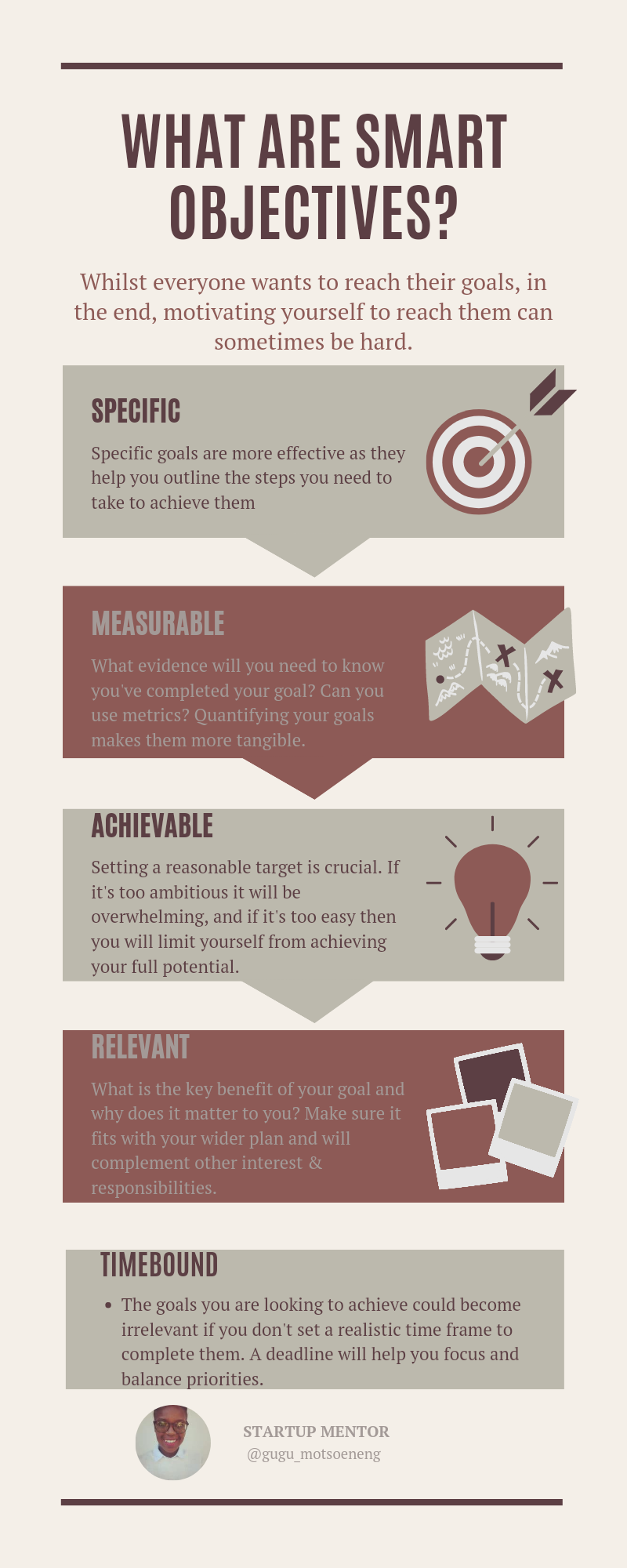
Be specific! There’s no use in setting a generic goal because it won’t suit you personally, however, if you adapt the goal to apply to what you need, then it will be much more valuable to you. Of course, you want to prosper in your field of work, but isn’t everyone in the office thinking the same?
M – measurable
Is it quantifiable? For instance, going back to the example objective of selling more, you can measure this by the number of units sold. Being a measurable goal allows you to identify when exactly it has been reached, i.e. what you desire as the end result.
A – achievable
The point of a target is to challenge and motivate yourself to complete a piece of work, if you were to set your target too high it can cause stress and so decrease the chance of your target actually being within reach. Likewise, if a target was too easy will inhibit you from pushing yourself and doing more. Setting yourself a reasonable target is crucial!
R – realistic
‘I’m going to own a multimillion-pound enterprise by the end of the month’ Might be a tad too ambitious, don’t get me wrong ambition is a leading trait, but maybe start with something more realistic, remember all successful business people don’t just become successful overnight.
T – time-bound
Deadlines. Not something we like, but something most of us need. Especially if you’re someone like me, who tends to procrastinate. For example, if you’re sitting at your desk knowing you have work to do, it’s easy to get lost in the world of the internet looking at cute animal photos or funny videos, but what if you were to say ‘Right, by 2 o’clock I want to have completed…’ then you’ve just motivated yourself to complete a job by an allotted time.
So why should you apply SMART goals to your working and even personal life?
Not only because it’s such a satisfying feeling to tick something off your To-do list but they can help you become more organized and sort out your priorities. They’re highly motivated and can give a sense of focus and purpose.







 Gugu Motsoeneng