Fund your business

Fund your business

It costs money to start a business. Funding your business is one of the first — and most important — financial choices most business owners make. How you choose to fund your business could affect how you structure and run your business.

Determine how much funding you’ll need

Every business has different needs, and no financial solution is one-size-fits-all. Your personal financial situation and vision for your business will shape the financial future of your business.

Once you know how much startup funding you’ll need, it’s time to figure out how you’ll get it.

Fund your business yourself with self-funding

Self-funding

Otherwise known as bootstrapping, self-funding lets you leverage your own financial resources to support your business. Self-funding can come in the form of turning to family and friends for capital, using your savings accounts, or even tapping into your 401(k).

With self-funding, you retain complete control over the business, but you also take on all the risk yourself. Be careful not to spend more than you can afford, and be especially careful if you choose to tap into retirement accounts early. You might face expensive fees or penalties, or damage your ability to retire on time — so you should check with your plan’s administrator and a personal financial advisor first.

Get venture capital from investors

Venture Capital from Investors

Investors can give you funding to start your business in the form of venture capital investments. Venture capital is normally offered in exchange for an ownership share and active role in the company.

Venture capital differs from traditional financing in a number of important ways. Venture capital typically:

• Focuses high-growth companies

• Invests capital in return for equity, rather than debt (it’s not a loan)

• Takes higher risks in exchange for potential higher returns

• Has a longer investment horizon than traditional financing

Almost all venture capitalists will, at a minimum, want a seat on the board of directors. So be prepared to give up some portion of both control and ownership of your company in exchange for funding.

How to get venture capital funding

There’s no guaranteed way to get venture capital, but the process generally follows a standard order of basic steps.

• Find an investor 
Look for individual investors — sometimes called “angel investors” — or venture capital firms. Be sure to do enough background research to know if the investor is reputable and has experience working with startup companies.

• Share your business plan
The investor will review your business plan to make sure it meets their investing criteria. Most investment funds concentrate on an industry, geographic area, or stage of business development.

• Go through due diligence review
The investors will look at your company’s management team, market, products and services, corporate governance documents, and financial statements.

• Work out the terms 
If they want to invest, the next step is to agree on a term sheet that describes the terms and conditions for the fund to make an investment.

• Investment
Once you agree on a term sheet, you can get the investment! Once a venture fund has invested, it becomes actively involved in the company. Venture funds normally come in “rounds.” As the company meets milestones, further rounds of financing are made available, with adjustments in price as the company executes its plan.

Use crowdfunding to fund your business

Crowdfunding

Crowdfunding raises funds for a business from a large number of people, called crowdfunders. Crowdfunders aren’t technically investors, because they don’t receive a share of ownership in the business and don’t expect a financial return on their money.

Instead, crowdfunders expect to get a “gift” from your company as thanks for their contribution. Often, that gift is the product you plan to sell or other special perks, like meeting the business owner or getting their name in the credits. This makes crowdfunding a popular option for people who want to produce creative works (like a documentary), or a physical product (like a high-tech cooler).

Crowdfunding is also popular because it’s very low risk for business owners. Not only do you get to retain full control of your company, but if your plan fails, you’re typically under no obligation to repay your crowdfunders. Every crowdfunding platform is different, so make sure to read the fine print and understand your full financial and legal obligations.

How to create a crowdfunding campaign is South Africa

The 10 Best Crowdfunding Websites for Raising Capital

Crowdfunding Platforms for SA Entrepreneurs

Get a small business loan

Small business loan

If you want to retain complete control of your business, but don’t have enough funds to start, consider a small business loan.

To increase your chances of securing a loan, you should have a business plan, expense sheet, and financial projections for the next five years. These tools will give you an idea of how much you’ll need to ask for, and will help the bank know they’re making a smart choice by giving you a loan.

Once you have your materials ready, contact banks and credit unions to request a loan. You’ll want to compare offers to get the best possible terms for your loan.

Need help? Get free business mentoring.
Calculate your startup costs

Calculate your startup costs

How much money will it take to start your small business? Calculate the startup costs for your small business so you can request funding, attract investors, and estimate when you’ll turn a profit.

Calculate your business startup costs before you launch

The key to a successful business is preparation. Before your business opens its doors, you’ll have bills to pay. Understanding your expenses will help you launch successfully.

Calculating startup costs helps you:

  • Estimate profits
  • Conduct a break-even analysis
  • Secure loans
  • Attract investors
  • Save money with tax deductions

Identify your startup expenses

Most businesses fall into one of three categories: brick-and-mortar businesses, online businesses, and service providers. You’ll face different startup expenses depending on your business type.

Brick and mortar
Online
Service

There are common startup costs you’re likely to have no matter what. Look through the following list, and make sure to add any other expenses that are unique to your business:

  • Office space
  • Equipment and supplies
  • Communications
  • Utilities
  • Licenses and permits
  • Insurance
  • Lawyer and accountant
  • Inventory
  • Employee salaries
  • Advertising and marketing
  • Market research
  • Printed marketing materials
  • Making a website

Estimate how much your expenses will cost

Once you have your list of expenses, you can estimate how much they’ll actually cost. This process will be different for each expense you have.

Some expenses will have well-defined costs — permits and licenses tend to have clear, published costs. You might have to estimate other costs that are less certain, like employee salaries. Look online and talk directly to mentors, vendors, and service providers to see what similar companies pay for expenses.

Add up your expenses for a full financial picture

Once you’ve identified your business expenses and how much they’ll cost, you should organize your expenses into one-time expenses and monthly expenses.

One-time expenses are the initial costs needed to start the business. Buying major equipment, hiring a logo designer, and paying for permits, licenses, and fees are generally considered to be one-time expenses. You can typically deduct one-time expenses for tax purposes, which can save you money on the amount of taxes you’ll owe. Make sure to keep track of your expenses and talk to your accountant when it’s time to file your taxes.

Monthly expenses typically include things like salaries, rent, and utility bills. You’ll want to count at least one year of monthly expenses, but counting five years is ideal.

Add up your one-time and monthly expenses to get a good picture of how much capital you’ll need and when you’ll need it.

Use your startup cost calculations to get startup funding

It’s a good idea to create a formal report of your expected startup costs.

You want it in a format that’s clear and easy to understand. Investors and lenders compare expected costs to projected revenue and determine the potential for your business to profit.

Need help? Get free business mentoring.

Why Thank-You ‘Cards’ Never Go Out of Style

Sometimes it’s the little things that make a big difference, especially in your job search.

You’d be surprised at how many candidates forget ‘common’ courtesies throughout the interview process, even when they know that making a great first impression is crucial. Remember, just as you are interviewing the company to make sure they are a good fit culturally for you, they are also hiring YOU, the person — not just the skills on your resume. Most companies would prefer a professional and polite candidate over a rude or unprofessional one.

Sadly, common courtesy, like common sense, is not all that common. The good news for you is that it is possible to shine like a diamond in a coal mine by practicing niceties and remembering your manners during the interview process. Now, it’s possible you don’t need this advice, as you are probably a courteous person the majority of the time, but interviews can be a bit nerve-wracking. It’s good to assume you are ‘on’ the second you exit your car the day of the interview. One company I worked with had the owner’s wife work the reception desk and believe me, they took note of how candidates treated her!

In addition to being genuinely pleasant to all you encounter, job interview thank-you notes are a much-neglected courtesy. A brief note or email to each person who interviewed you is appropriate and should be sent the day after the interview. Make sure you know the correct spelling of the name, and if you send the note to more than one person, individualize each one. The purpose of the interview thank-you email is simply to thank the interviewer for their time and to state your interest in the position. Of those two items, the thanking is the most important. A full-court press at this stage will dilute the effectiveness of the thank you.

Emailed thank-you notes are also perfectly acceptable, but handwritten ones on a simple, elegant note card are rare enough to really make you stand apart from the crowd. This doesn’t go without saying, but if you do opt for a handwritten thank you, make sure your writing is legible.

It’s all about making a positive impression and showing yourself as the best investment. So good luck, and happy job searching!

Want to see how your resume stacks up? Email your current resume to info@orangememo.co.za and request a free resume critique today!

Break-Even Point

Calculate your startup costs

The break-even point is the point at which total cost and total revenue are equal, meaning there is no loss or gain for your small business. In other words, you’ve reached the level of production at which the costs of production equals the revenues for a product.

For any new business, this is an important calculation in your business plan. Potential investors in a business not only want to know the return to expect on their investments, but also the point when they will realize this return. This is because some companies may take years before turning a profit, often losing money in the first few months or years before breaking even. For this reason, break-even point is an important part of any business plan presented to a potential investor.

For existing businesses, this can be a useful tool not only in analyzing costs and evaluating profits they’ll earn at different sales volumes, but also to prove their potential turnaround after disaster scenarios.

Benefits of a break-even analysis:

✔ Price Smarter
✔ Catch Missing Expenses
✔ Set Revenue Targets
✔ Make Smarter Decisions
✔ Limit Financial Strain
✔ Fund Your Business

Breakeven Point Analysis

Tips and tricks

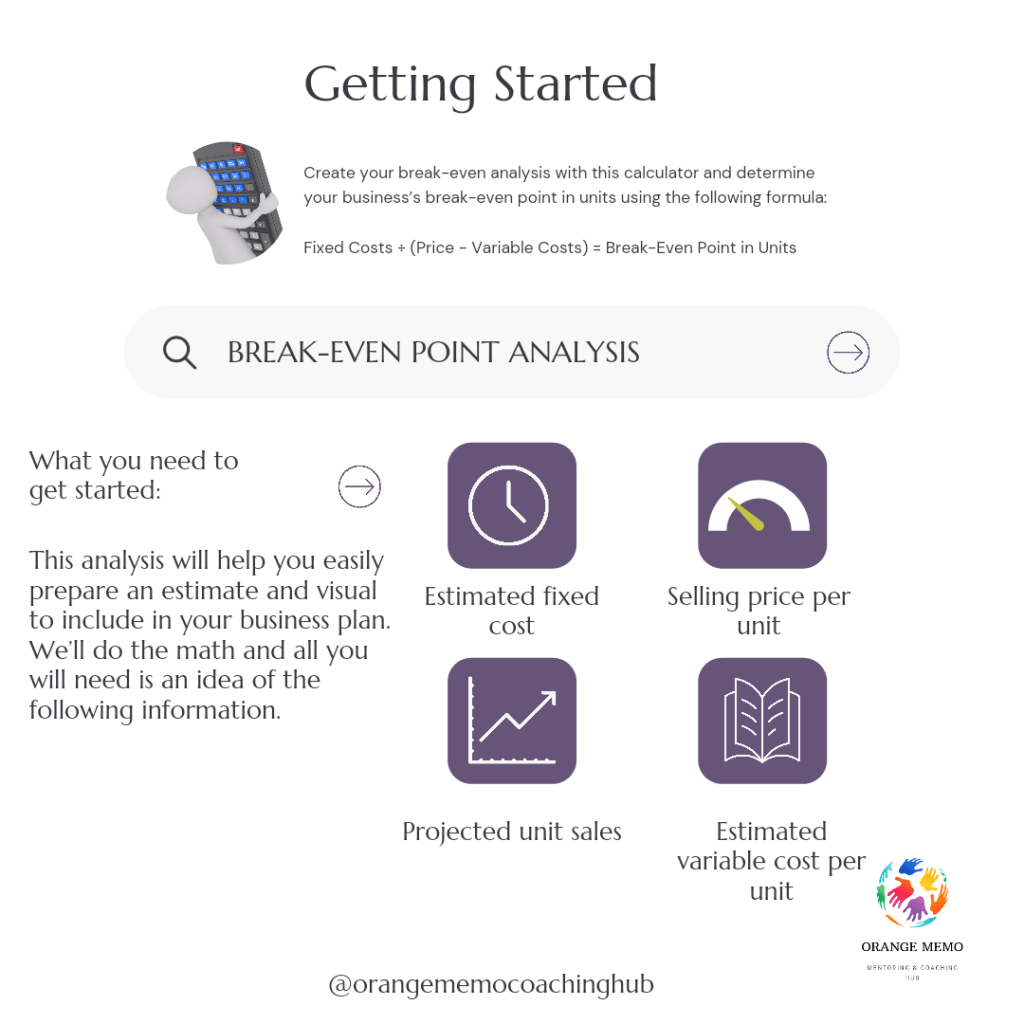
Use the break-even formula

This break-even analysis is based on the foundation of a single product or service.

To calculate the break-even point in units we use the formula:
Break-even point (units) = fixed costs ÷ (sales price per unit – variable cost per unit)

Or in sales rands (dollars) using the formula:
Break-even point (sales dollars) = fixed costs ÷ contribution margin

Contribution Margin is the difference between the price of a product and what it costs to make that product.

The calculation is as follows:
Contribution margin = (sale price per unit – variable cost per unit) ÷ sale price per unit

Calculate multiple products or services

The total fixed costs, variable costs, unit or service sales are calculated on a monthly basis in this calculator. Meaning that adding the total for all products and services monthly should account for all products and services. You may also want to do the calculation individually for each product or service if the products or service sales vary per month.

Remember the break-even point is used as an estimate for lender viability and your business plan. It is not intended to 100% accurately determine your accounting or financing since those calculations can only be done after all costs and production have occurred. It’s also a good idea to throw a little extra, say 10%, into your break-even analysis to cover miscellaneous expenses that you can’t predict.

Learn about fixed costs

Fixed costs are costs incurred during a specific period of time that do not change with the increase or decrease in production or services. Once established, fixed costs do not change over the life of an agreement or cost schedule. For this calculator we are calculating the fixed costs on a monthly basis.

If you have fixed costs that do not incur monthly you should still include them, but calculate the monthly amount that goes towards that expense. For example if something is paid for on a quarterly basis, but does not change with production you would divide that cost by four in order to estimate the monthly amount of that cost. In the break-even analysis we will help you break down the potential fixed costs related to your business.

Examples of fixed costs include:

• Rental lease payments

• Salaries

• Property taxes

• Insurance

• Interest

Learn about semi-variable costs

Sometimes determining whether a cost is fixed or variable is more complicated.

There is also a category of costs that falls in between, known as semi-variable costs (also known as semi-fixed costs or mixed costs). These are costs composed of a mixture of both fixed and variable components. Costs are fixed for a set level of production or consumption and become variable after this production level is exceeded. If no production occurs, a fixed cost is often still incurred.

The best way to include these costs is to separate out the part that is variable from the part that is fixed. These may include minimum payments or fees for services and products. For the break-even analysis to be as accurate as possible it is important to separate any semi-variable costs into their fixed and variable parts if possible.

Examples of semi-variable costs include:

• Monthly telephone services

• Repairs

• Indirect materials

• Indirect labor

• Fuel

• Power

NOTE!

Do ask for help. Sometimes it is difficult to estimate and project data. Feel free to email me at gugu@orangememo.co.za and I will gladly help you (in the subject line please put “Break-Even Analysis: need help with the “estimates and projections”).

The Secret to Happiness Is Helping Others

There is a Chinese saying that goes: “If you want happiness for an hour, take a nap. If you want happiness for a day, go fishing. If you want happiness for a year, inherit a fortune. If you want happiness for a lifetime, help somebody.” For centuries, the greatest thinkers have suggested the same thing: Happiness is found in helping others.

“Giving back is as good for you as it is for those you are helping because giving gives you purpose. When you have a purpose-driven life, you’re a happier person.” — Goldie Hawn

And so we learn early: It is better to give than to receive.

Helping others may just be the secret to living a life that is not only happier but also healthier, wealthier, more productive, and meaningful.

But it’s important to remember that giving doesn’t always feel great. The opposite could very well be true: Giving can make us feel depleted and taken advantage of.

Here are some tips that will help you give not until it hurts, but until it feels great:

1. Find your passion

Our passion should be the foundation for our giving. It is not how much we give, but how much love we put into giving.

2. Give your time

The gift of time is often more valuable to the receiver and more satisfying for the giver than the gift of money. We don’t all have the same amount of money, but we all do have time on our hands, and can give some of this time to help others—whether that means we devote our lifetimes to service, or just give a few hours each day or a few days a year.

4. Find ways to integrate your interests and skills with the needs of others

“Selfless giving, in the absence of self-preservation instincts, easily becomes overwhelming,” says Adam Grant, author of Giving & Take. It is important to be “otherish,” which he defines as being willing to give more than you receive, but still keeping your interests insight.

5. Be proactive, not reactive

We have all felt the dread that comes from being persuaded into giving, such as when friends ask us to donate to their fundraisers. In these cases, we are more likely to give to avoid humiliation rather than out of generosity and concern. This type of giving doesn’t lead to a warm glow feeling; more likely it will lead to resentment. Instead, we should set aside time, think about our options, and find the best charity for our values.

6. Don’t be guilt-tripped into giving

I don’t want to discourage people from giving to good causes just because that doesn’t always cheer us up. If we gave only to get something back each time we gave, what a dreadful, opportunistic world this would be! Yet if we are feeling guilt-tripped into giving, chances are we will not be very committed over time to the cause.

The key is to find the approach that fits us. When we do, then the more we give, the more we stand to gain purpose, meaning, and happiness—all of the things that we look for in life but are so hard to find.

Pick a Business Plan that works for you

What is a Business Plan?

A business plan is a formal written document containing the goals of a business, the methods for attaining those goals, and the time frame for the achievement of the goals.

Pick a business plan format that works for you

There’s no right or wrong way to write a business plan. What’s important is that your plan meets your needs.

Most business plans fall into one of two common categories: traditional or lean startup.

Traditional business plans are more common, use a standard structure, and encourage you to go into detail in each section, take more time to write, and are comprehensive. They tend to require more work upfront and can be dozens of pages long. Lenders and investors commonly request this plan.

Lean startup business plans are less common but still use a standard structure. They focus on summarizing only the most important points of the key elements of your plan. They can take as little as one hour to make and are typically only one page. Some lenders and investors may ask for more information.


Traditional business plan format

You might prefer a traditional business plan format if you’re very detail-oriented, want a comprehensive plan, or plan to request financing from traditional sources.

When you write your business plan, you don’t have to stick to the exact business plan outline. Instead, use the sections that make the most sense for your business and your needs. Traditional business plans use some combination of these nine sections.

Executive summary

Briefly tell your reader what your company is and why it will be successful. Include your mission statement, your product or service, and basic information about your company’s leadership team, employees, and location. You should also include financial information and high-level growth plans if you plan to ask for financing.

Company description

Use your company description to provide detailed information about your company. Go into detail about the problems your business solves. Be specific, and list out the consumers, organization, or businesses your company plans to serve.

Explain the competitive advantages that will make your business a success. Are there experts on your team? Have you found the perfect location for your business? Your company description is the place to boast about your strengths.

Market analysis

You’ll need a good understanding of your industry outlook and target market. Competitive research will show you what other businesses are doing and what their strengths are. In your market research, look for trends and themes. What do successful competitors do? Why does it work? Can you do it better? Now’s the time to answer these questions.

Organization and management

Tell your reader how your company will be structured and who will run it.

Describe the legal structure of your business. State whether you have or intend to incorporate your business as a Private Company (Pty Ltd), or partnership, or if you’re a sole proprietor.

Use an organizational chart to lay out who’s in charge of what in your company. Show how each person’s unique experience will contribute to the success of your venture. Consider including resumes and CVs of key members of your team.

Service or product line

Describe what you sell or what service you offer. Explain how it benefits your customers and what the product lifecycle looks like. Share your plans for intellectual property, like copyright or patent filings. If you’re doing research and development for your service or product, explain it in detail.

Marketing and sales

There’s no single way to approach a marketing strategy. Your strategy should evolve and change to fit your unique needs.

Your goal in this section is to describe how you’ll attract and retain customers. You’ll also describe how a sale will actually happen. You’ll refer to this section later when you make financial projections, so make sure to thoroughly describe your complete marketing and sales strategies.

Funding request

If you’re asking for funding, this is where you’ll outline your funding requirements. Your goal is to clearly explain how much funding you’ll need over the next five years and what you’ll use it for.

Specify whether you want debt or equity, the terms you’d like applied, and the length of time your request will cover. Give a detailed description of how you’ll use your funds. Specify if you need funds to buy equipment or materials, pay salaries, or cover specific bills until revenue increases. Always include a description of your future strategic financial plans, like paying off debt or selling your business.

Financial projections

Supplement your funding request with financial projections. Your goal is to convince the reader that your business is stable and will be a financial success.

If your business is already established, include income statements, balance sheets, and cash flow statements for the last three to five years. If you have other collateral you could put against a loan, make sure to list it now.

Provide a prospective financial outlook for the next five years. Include forecasted income statements, balance sheets, cash flow statements, and capital expenditure budgets. For the first year, be even more specific and use quarterly — or even monthly — projections. Make sure to clearly explain your projections, and match them to your funding requests.

This is a great place to use graphs and charts to tell the financial story of your business.  

Appendix

Use your appendix to provide supporting documents or other materials that were specially requested. Common items to include are credit histories, resumes, product pictures, letters of reference, licenses, permits, patents, legal documents, and other contracts.

Example traditional business plans

Before you write your business plan, read the following example business plans written by fictional business owners. Rebecca owns a consulting firm.

Lean startup format

You might prefer a lean startup format if you want to explain or start your business quickly, your business is relatively simple, or you plan to regularly change and refine your business plan.

Lean startup formats are charts that use only a handful of elements to describe your company’s value proposition, infrastructure, customers, and finances. They’re useful for visualizing tradeoffs and fundamental facts about your company.

There are different ways to develop a lean startup template. You can search the web to find free templates to build your business plan. We discuss nine components of a model business plan here:

Key partnerships

Note the other businesses or services you’ll work with to run your business. Think about suppliers, manufacturers, subcontractors, and similar strategic partners.

Key activities

List the ways your business will gain a competitive advantage. Highlight things like selling direct to consumers, or using technology to tap into the sharing economy.

Key resources

List any resource you’ll leverage to create value for your customer. Your most important assets could include staff, capital, or intellectual property.

Value proposition

Make a clear and compelling statement about the unique value your company brings to the market.

Customer relationships

Describe how customers will interact with your business. Is it automated or personal? In-person or online? Think through the customer experience from start to finish.

Customer segments

Be specific when you name your target market. Your business won’t be for everybody, so it’s important to have a clear sense of whom your business will serve.

Channels

List the most important ways you’ll talk to your customers. Most businesses use a mix of channels and optimize them over time.

Cost structure

Will your company focus on reducing cost or maximizing value? Define your strategy, then list the most significant costs you’ll face pursuing it.

Revenue streams

Explain how your company will actually make money. Some examples are direct sales, memberships fees, and selling advertising space. If your company has multiple revenue streams, list them all.


Business plans help you run your business

A good business plan guides you through each stage of starting and managing your business. You’ll use your business plan as a roadmap for how to structure, run, and grow your new business. It’s a way to think through the key elements of your business.

Business plans can help you get funding or bring on new business partners. Investors want to feel confident they’ll see a return on their investment. Your business plan is the tool you’ll use to convince people that working with you — or investing in your company — is a smart choice.

Example lean business plan

Before you write your business plan, read this example business plan written by a fictional business owner, Andrew, who owns a toy company.

Need help? Get free business mentoring.

Porter’s Five Forces

What are the Porter’s Five Forces?

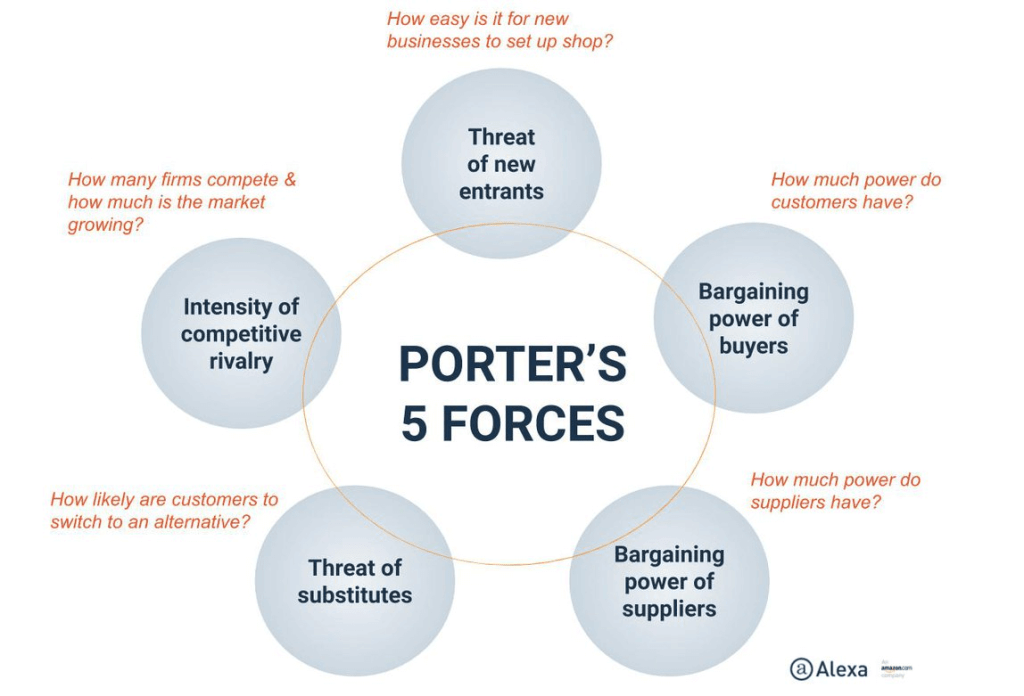
  1. Supplier power: this force is an assessment of how easy it is for suppliers to drive prices up. It’s typically completed by determining the number of suppliers who can offer the same supply, the cost of switching suppliers, and any unique aspects of benefits the supplier can offer.
  2. Buyer power: Next, you determine how easy it is for buyers to drive prices down. This is determined by the total number of buyers your business has, customer acquisition cost, customer lifetime value, and other factors that may give the buyer (customers) leverage to negotiate for lower prices, or go elsewhere.
  3. Rivalry among existing competitors: The main drivers of this force are the number of and capability of competitors in the market. More numerous and powerful competitors with larger market share diminishes the power of any one smaller company, and gives both customers and suppliers more leverage (because of their ability to go elsewhere).
  4. Threat of substitute products/services: When close substitute products exist in a market, it increases the likelihood of customers switching to alternative products in response to price increases.
  5. Threat of new entrants: Profitable markets attract new entrants, which in turn erodes profitability. Unless incumbents have strong and durable barriers to new entrants, profitability will decline. Conversely, the more unique your product is from other competitors, the less threat is posed by new entrants.

Why is Porter’s Five Forces analysis important?

Porter’s Five Forces forces model is useful because it can provide insight on various parts of a business:

  • Determine the factors affecting profitability: Completing a Five Forces analysis will help a business understand the specific factors that may be hindering growth or profitability, and then find new competitive advantages.
  • Make better decisions on expansion or capacity: If you’re considering expanding your business in some way, you’ll want to understand the competitive forces at play and how they may affect you. A Five Forces analysis provides organizations with the information to make good decisions relating to entering a specific industry, or whether to increase.
  • Inform your overall strategy: By understanding what shapes the overall market and what determines profitability, you can craft a strategy that plays to the strengths of your industry and accounts for the weaknesses.

How to Use Porter’s 5 Forces

With Miro’s Five Forces analysis template, you can easily complete the analysis on your own. Here’s how you do it:

Step 1: Consider threats of new entry

How easily could others enter your market and threaten your company’s position? Who are your new competitors? How much does it cost to enter your market? What are the barriers to entry? Is your market tightly regulated? What does it take to scale?

Think about the amount of competition your company faces: the number of competitors you have and how their products or services compare to yours. If your market has few competitors, that can seem attractive, but keep in mind it might be short-lived. If your market is highly competitive, that can seem unattractive, but it might push you to improve your products and your pricing.

Step 2: Consider threats of substitution

What is the likelihood that your customers will replace your product or service with a different one? Are there any viable substitutes on the market? What is the cost of switching to a substitute? 

When you map out threats of substitution, analyze how your product has impacted your customers’ lives. As their behavior changes, see if you can adapt your product accordingly. You might be able to offer a new service or a cheaper alternative.

Step 3: Consider the bargaining power of suppliers

What would happen if your suppliers increased their prices? Is that likely to happen? How easily could you switch to an alternative supplier? 

It’s important to keep in mind that your supplier is a business too. They are performing the same strategic calculations that you are. If your supplier offers a niche service, they could charge you more and impact your bottom line.

Step 4: Consider the bargaining power of buyers

How many buyers do you have? Could your buyers switch suppliers? How many would need to switch suppliers to impact your bottom line? How important is your product or service to your buyers?

Like your supplier, your buyers’ calculations could seriously impact your bottom line too. These questions help you figure out how much leverage your buyers have. Even if your buyers are not businesses, it’s important to treat them that way. They are business-savvy, often shopping around to see how your competitors measure up.

Step 5: Consider competitive rivalries.

Who are your existing competitors? How strong are they? How do their products or services compare to yours? What sets your company apart? What would it cost your customer to switch to a competitor?

Draw out your current competitive landscape. Understand how your competitors are succeeding and why they’re failing. Many businesses make the mistake of only analyzing what makes them better than their competition. It is crucial to understand what makes your competition better than you. Be honest! It’s the only way you can get ahead.

Competition Analysis

Use competitive analysis to find a market advantage

Competitive analysis helps you learn from businesses competing for your potential customers. This is key to defining a competitive edge that creates sustainable revenue.

Your competitive analysis should identify your competition by product line or service and market segment. Assess the following characteristics of the competitive landscape:

  • Market share
  • Strengths and weaknesses
  • Your window of opportunity to enter the market
  • The importance of your target market to your competitors
  • Any barriers that may hinder you as you enter the market
  • Indirect or secondary competitors who may impact your success

Several industries might be competing to serve the same market you’re targeting. Read Porter’s Five Forces as one way you can differentiate your competitive analysis by industry. Important factors to consider include level of competition, threat of new competitors or services, and the effect of suppliers and customers on price.

Market Research

Use market research to find customers

Market research blends consumer behavior and economic trends to confirm and improve your business idea.

It’s crucial to understand your consumer base from the outset. Market research lets you reduce risks even while your business is still just a gleam in your eye.

Gather demographic information to better understand opportunities and limitations for gaining customers. This could include population data on age, wealth, family, interests, or anything else that’s relevant for your business.

Then answer the following questions to get a good sense of your market:

  • Demand: Is there a desire for your product or service?
  • Market size: How many people would be interested in your offering?
  • Economic indicators: What are the income range and employment rate?
  • Location: Where do your customers live and where can your business reach?
  • Market saturation: How many similar options are already available to consumers?
  • Pricing: What do potential customers pay for these alternatives?

You’ll also want to keep up with the latest small business trends. It’s important to gain a sense of the specific market share that will impact your profits.

You can do market research using existing sources, or you can do the research yourself and go direct to consumers.

Existing sources can save you a lot of time and energy, but the information might not be as specific to your audience as you’d like. Use it to answer questions that are both general and quantifiable, like industry trends, demographics, and household incomes.

Asking consumers yourself can give you a nuanced understanding of your specific target audience. But, direct research can be time consuming and expensive. Use it to answer questions about your specific business or customers, like reactions to your logo, improvements you could make to buying experience, and where customers might go instead of your business.

Here are a few methods you can use to do direct research:

  • Surveys
  • Questionnaires
  • Focus groups
  • In-depth interviews

For guidance on deciding which methods are worthwhile for your small business, Orange Memo provides counseling services.

Design a site like this with WordPress.com
Get started