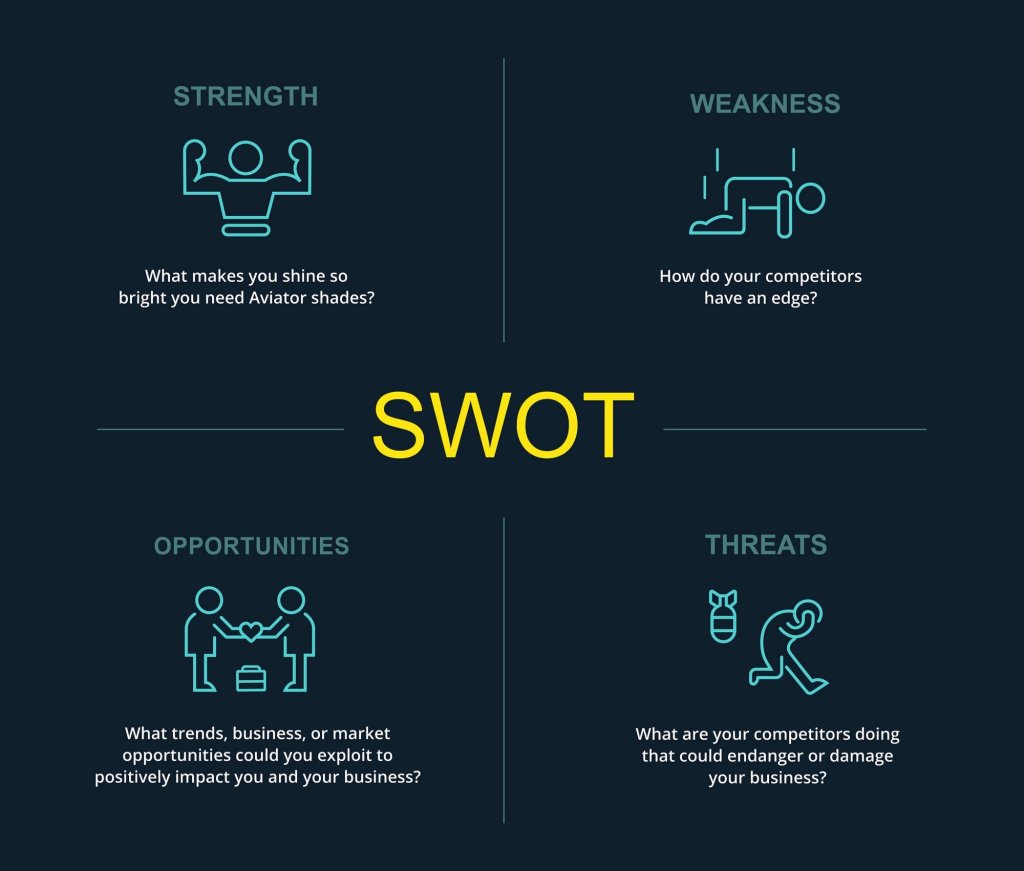
Personal SWOT Analysis

SWOT Analysis

Making the Most of Your Talents and Opportunities

“Chance favors the prepared mind.”– Louis Pasteur

You are most likely to succeed in life if you use your talents to their fullest extent. Similarly, you’ll suffer fewer problems if you know what your weaknesses are and if you manage these weaknesses so that they don’t matter in the work you do.

So how do you go about identifying these strengths and weaknesses, and analyzing the opportunities and threats that flow from them? SWOT Analysis is a useful technique that helps you do this.

What makes SWOT especially powerful is that, with a little thought, it can help you uncover opportunities that you would not otherwise have spotted. And by understanding your weaknesses, you can manage and eliminate threats that might otherwise hurt your ability to move forward.

If you look at yourself using the SWOT framework, you can start to separate yourself from your peers, and further develop the specialized talents and abilities you need to advance your career and help you achieve your personal goals.

How to Use the Tool

To perform a personal SWOT analysis, first print out our free worksheet, and write down answers to the following questions.

Strengths

• What advantages do you have that others don’t have (for example, skills, certifications, education, or connections)?

• What do you do better than anyone else?

• What personal resources can you access?

• What do other people (and your boss, in particular) see as your strengths?

• Which of your achievements are you most proud of?

• What values do you believe in that others fail to exhibit?

• Are you part of a network that no one else is involved in? If so, what connections do you have with influential people?

Consider this from your own perspective, and from the point of view of the people around you. And don’t be modest or shy – be as objective as you can. Knowing and using your strengths can make you happier and more fulfilled at work.

And if you still have any difficulty identifying your strengths, write down a list of your personal characteristics. Some of these will hopefully be strengths!

Tip:

Think about your strengths in relation to the people around you. For example, if you’re a great mathematician and the people around you are also great at math, then this is not likely to be a strength in your current role – it may be a necessity.

Weaknesses

• What tasks do you usually avoid because you don’t feel confident doing them?

• What will the people around you see as your weaknesses?

• Are you completely confident in your education and skills training? If not, where are you weakest?

• What are your negative work habits (for example, are you often late, are you disorganized, do you have a short temper, or are you poor at handling stress)?

• Do you have personality traits that hold you back in your field? For instance, if you have to conduct meetings on a regular basis, a fear of public speaking would be a major weakness.

Again, consider this from a personal/internal perspective and an external perspective. Do other people see weaknesses that you don’t see? Do co-workers consistently outperform you in key areas? Be realistic – it’s best to face any unpleasant truths as soon as possible.

Opportunities

• What new technology can help you? Or can you get help from others or from people via the internet?

• Is your industry growing? If so, how can you take advantage of the current market?

• Do you have a network of strategic contacts to help you, or offer good advice?

• What trends (management or otherwise) do you see in your company, and how can you take advantage of them?

• Are any of your competitors failing to do something important? If so, can you take advantage of their mistakes?

• Is there a need in your company or industry that no one is filling?

• Do your customers or vendors complain about something in your company? If so, could you create an opportunity by offering a solution?

You might find useful opportunities in the following:

• Networking events, educational classes, or conferences.

• A colleague going on an extended leave. Could you take on some of this person’s projects to gain experience?

• A new role or project that forces you to learn new skills, like public speaking or international relations.

• A company expansion or acquisition. Do you have specific skills (like a second language) that could help with the process?

Also, importantly, look at your strengths, and ask yourself whether these open up any opportunities – and look at your weaknesses, and ask yourself whether you could open up opportunities by eliminating those weaknesses.

Threats

• What obstacles do you currently face at work?

• Are any of your colleagues competing with you for projects or roles?

• Is your job (or the demand for the things you do) changing?

• Does changing technology threaten your position?

• Could any of your weaknesses lead to threats?

Performing this analysis will often provide key information – it can point out what needs to be done and put problems into perspective.

A Personal SWOT Example

What would a personal SWOT assessment look like? Review this SWOT analysis for Carol, an advertising manager.

Strengths

• I’m very creative. I often impress clients with a new perspective on their brands.

• I communicate well with my clients and team.

• I have the ability to ask key questions to find just the right marketing angle.

• I’m completely committed to the success of a client’s brand.

Weaknesses

• I have a strong, compulsive need to do things quickly and remove them from my “to do” list, and sometimes the quality of my work suffers as a result.

• This same need to get things done also causes me stress when I have too many tasks.

• I get nervous when presenting ideas to clients, and this fear of public speaking often takes the passion out of my presentations.

Opportunities

• One of our major competitors has developed a reputation for treating their smaller clients poorly.

• I’m attending a major marketing conference next month. This will allow for strategic networking, and also offer some great training seminars.

• Our art director will go on maternity leave soon. Covering her duties while she’s away would be a great career development opportunity for me.

Threats

• Simon, one of my colleagues, is a much stronger speaker than I am, and he’s competing with me for the art director position.

• Due to recent staff shortages, I’m often overworked, and this negatively impacts my creativity.

• The current economic climate has resulted in slow growth for the marketing industry. Many firms have laid off staff members, and our company is considering further cutbacks.

As a result of performing this analysis, Carol takes the bold step of approaching her colleague Simon about the art director’s maternity leave. Carol proposes that both she and Simon cover the job’s duties, working together and each using his or her strengths. To her surprise, Simon likes the idea. He knows he presents very well, but he admits that he’s usually impressed by Carol’s creative ideas, which he feels are far better than most of his.

By working as a team, they have a chance to make their smaller clients feel even better about the service they’re getting. This takes advantage of their competitor’s weakness in this area.
Why Brand Names Are So Important, According To Science

Brand Names

Coca-Cola. Kleenex. Netflix. Google. Brand names surround us, often to the point that they become a natural part of our everyday speech.

As any successful entrepreneur can tell you, there are countless components to creating a successful brand – the most important of which, of course, is providing a good product or service.

Still, however, the brand name itself carries more weight than you might think – and can mark the difference between a brand that gains traction and one that falls flat.

Here’s the science behind why certain brand names stick and others don’t.

Learning words is more than just memorizing meanings!

When we’re children, our minds are like blank slates: uncontaminated by experience, we learn about the world by absorbing our surroundings.

A crucial part of this learning process is developing a vocabulary. Indeed, by the time we’re 10 years old, most of us will already know 10,000 words – a figure that more than doubles by the time we reach adulthood.

But learning a word entails a lot more than mapping a meaning to a sequence of sounds. It involves a whole network of associations, which affect how we think and feel about that word.

Take “cat,” for instance. At face value, a “cat” is a four-legged feline mammal that is a common household pet.

Now, suppose that your next-door neighbor had a fluffy and sociable cat when you were growing up. As a result of this, you might associate the word “cat” with positive emotions, like affection.

Alternatively, if your neighbor’s cat always hissed at you, you might associate the word “cat” with negative emotions, like fear. Either way, the word “cat” makes you not only think about cats, but how you feel about them, too.

That’s whole idea behind implicit-association tests: throughout the years, we’ve cultivated positive and negative connotations about certain words that are so ingrained in our brains that we don’t even realize it.

With this in mind, let’s revisit the vocabulary statistics we mentioned above. The average English-speaking adult has a vocabulary size of around 30,000 words (some estimates are even higher).

By the time we’re adults, the connotations we’ve associated with these words are pretty solid. We either like cats, or we don’t. Our minds are no longer blank slates like they were when we were toddlers.

Brand names are words, too!

So what does this have to do with branding? Michael Rader, founder of Brandroot, a marketplace for .com domain names, explains: “Brand names are words, too,” he says. “So the first time we hear a brand name, we have no preconceived conceptions about it.”

Let’s take a real-life example. Even though we’ve formed concrete feelings about the word “shoe,” when we hear about a brand called “Nike” for the first time, suddenly we’re babies again: we learn to associate positive or negative connotations with the word “Nike” based on our experiences.

As Rader points out, this gives businesses a lot of control in how people interpret their brand. “Brand names give businesses the opportunity to put a meaning behind their name with completely positive connotations,” Rader says.

So, if your brand delivers a quality product, gets good press, and aligns with your customers’ values, your customers will begin to associate your brand with positive connotations – just like you did with your neighbor’s fluffy cat when you were a child.

Rader concisely sums up the importance of this: “If somebody automatically associates your brand name with positive emotions, you’ve earned yourself a customer for life.”

What about brand names that are already words?

An astute reader might wonder, “What about brands like Facebook, which consist of words that already exist?”

Here, the important thing isn’t the words themselves, but rather the combination of the words in question.

To illustrate, think of the word “off.” If an alarm goes off, it means one thing; if an alarm turns off, it means quite another. This shows that it’s not necessarily individual words that supply meaning, but rather their relationship to other words.

For that reason, brand names that consist of two words, like “face” and “book” – which, previous to 2004, had rarely been seen in combination – are still processed as novel words, and are still subject to the same “blank slate” effect as described above. (JetBlue, MasterCard, and Snapchat are other notable examples, among many.)

Of course, there are some companies whose names don’t have any novelty at all – think of the now-defunct pets.com or toys.com. As these examples suggest, these brands names are hard to work with, as you can never truly break away from your customers’ preconceived notions of your brand.

Still, some businesses have had success with this approach. “In my business, it’s more important that people immediately know what I’m offering than it is to build connotations behind my brand name,” says Brandon Hieber, CEO of The Old School Game Vault.

For the vast majority of business owners, however, the goal is to build a brand – and ideally, one that’s associated with positive connotations for the consumer.

And that’s why your brand name is so important. It gives customers a chance to learn a new word and imbue it with fresh connotations as if they were children.

That way, people learn to mentally link your brand with good things right from the get-go – which, like a fluffy and sociable neighborhood cat, can create a positive association that lasts a lifetime.

Getting to know your own business: How an internal inventory can help reduce project costs

Missed requirements cost money, so before engaging with vendors startup companies should know their own business.  Often the knowledge of how you do what you do is scattered among departments, company documents, and people.  Having an inventory of your company’s inner workings in one central place before engaging with your software vendor is a vital step to ensuring that your requirements are complete and accurate.

It is widely known that it is far less costly to fix requirement misses than to fix bugs or add functionality later. Therefore, it is worth the effort to identify and ensure that those critical but not widely known processes are included in the final solution before development starts.

Before embarking on the detailed work of requirements analysis and documentation with your software vendor, the first internal discussions should almost toss software completely out the window and talk about what people do in each process, what regulatory agencies are about to make them do, what “Sibusiso” does, and what you plan to do in the future. 

This may seem like a waste of valuable hours away from desks, but it allows experienced people from pertinent areas in the company to define what they are doing without determining how the system should be doing it.  I have found that people tend to be most animated, creative, and collaborative when they talk about what they know without imposing boundaries of what the system should do or trying to define how the system should do it.

One of the deliverables of these sessions should be a comprehensive set of documentation on what people do in each process. This should include all entry and exit points to each process, including those steps thought to be far downstream of the new system. For example, perhaps a specific bar code font must be supported so that when a document generated by the new system is returned by the recipient it can be read by equipment that is not linked to the new system in any other way, but it needs to read the bar code. This is just one example of requirements that may be missed in a normal requirement gathering session with your software vendor. 

The following existing resources will help identify more elusive but critical requirements:

Company Handbooks.  Training, Process, and Regulation Manuals often contain detailed calculations, processes, and rules that will not only help with system definition but may describe activities currently done outside the system, maybe with pencil and paper, that can be incorporated into the new system.  Reviewing training manuals can reduce missed requirements and reduce the cost of elaboration, since the documentation may only need translation into formal requirements.

Correspondence Library.  Correspondence is usually mentioned in process discussions, but only as a reference, such as, “then we send a quote”.  Documents, for example, are complex pieces of work.  In addition to document wording and layout, to get it right the first time your software vendor will need a list of the pieces of information required from other areas in the system (client name, email address, requested information, etc.), a list of those who may receive the document or a copy of it, the trigger conditions for an automatically generated document and the period the document is effective.

Data.  Finally, as a mop-up, it is helpful to analyze the current system data and database structure.  Analyzing and summarizing information gleaned from existing data can reveal an immense amount of information that can be helpful when defining requirements for the new system.  For example:

How many items (such as payments) are processed each day?  The answer to this question will help with performance requirements, batch scheduling, high volume day trends, projections for a future volume, per invoice payment analysis, per payment transaction analysis, etc.  Date/time stamps can be used to find the current average time to process an item.

What’s this table for?  “Oh, Sibusiso uses this table for that thing he does.”  Analysis of tables that don’t seem to fit with the general data model can be helpful.  They can spawn discussions about processes that were inadvertently missed but are needed, and identify reports that are run every day that should be discarded because nobody reads them.

Ultimately, the more sources of information used to assemble your vision for a new software solution the better, more intuitive, and well-rounded the solution will be.  This means creating an inventory of your business using existing documentation of all forms as well as gleaning from the expertise of people who will be using it.  Taking the time upfront will reduce the final cost of requirement documentation hours, development, and testing.  It is also likely to increase user satisfaction and reduce missed requirements.

Now that you are ready for us, let’s talk about how Orange Memo can help you make your vision real.

Differentiation Strategy: How to Gain Competitive Advantage Through Product Leadership

Differentiating Strategy

There are many options for differentiating a brand, depending on the company’s internal capabilities and competitive environment. In this post, I will talk about how to gain a competitive advantage through product differentiation.

Differentiation Strategy: 3 Important Questions

Before developing the differentiation strategy marketers should have the answer to these questions:

• Is my brand the first in the category to claim this differentiating idea? If one of your competitors already owns that positioning your best bet is to explore a different option.

• Will my company be able and willing to deliver on that competitive advantage over a long period? Brand building takes a long time, consistency, and perseverance.  If management is not willing to allocate the necessary resources (which vary depending on the industry and level of competition) then your strategy will die in its infant stages.

• Does my differentiation idea translate into a meaningful benefit for the consumer? If the consumer is not willing to pay for it then you have to start from scratch.

What Is Product-Based Differentiation

This differentiation strategy involves using the characteristics of the product you market to differentiate from your competitors.

Every brand is built on a product (I include services here as well). As a result, especially in the early stages of the brand-building process where not enough emotional connections have been built, product-based positioning might be one of the very few options available.

Is Differentiating On Products The Right Strategy For My Brand?

Companies most successful in using this strategy are those who focus on product innovation. They invest important resources in researching, developing, and introducing new products and improving the existing ones.

How Do I Differentiate On Product

There are many benefits that consumers value and look for when purchasing a product. Below are the most common ways to create differentiation:

Product features– a product that solves problems faster, or solves the same problem cheaper is worth paying more for. Hyundai has positioned itself as a car company that offers “more vehicles” for the money. The Brand Manager needs to establish what the cost/benefit ratio is before deciding to add a product feature and use it as a differentiation element. If the overall cost is higher than the premium that can be charged for it this strategy is not worth pursuing.

The manufacturing process- how the product is made can be a great way to set your brand apart from the competition. In today’s economy where most products have become commodities, the “secret ingredient” or “proprietary technology” can make the difference. Lululemon®, a well-known Canadian manufacturer of yoga-inspired apparel, has built its success on the proprietary luon®, a fabric that provides shape retention and great stretching capabilities. The brand has become synonymous with yoga apparel and dominates the segment against giants such as Nike and Adidas.

Performance– is another great product attribute that can be used to separate your brand from the competition. BMW makes great use of this concept by positioning their cars as “The ultimate driving machine.” Cervelo’s dedication to designing and building aerodynamic bikes is what helped the brand carve a distinctive niche in the super-competitive race bike segment dominated by much bigger players such as Trek, Specialized, and Giant. Their slogan, “Speed. Engineered.” is a great reflection of their philosophy.

Design– Attractive, unique product design is a very effective way to differentiate. Apple is constantly pursuing this strategy which reflects in the entire assortment, from iPods to MacBooks.

Italian companies frequently pursue this strategy, be it in cars (Ferrari), clothes (Gucci), or bicycles (Pinarello, Cogliano). Nordic European countries are famous around the world for their design that combines simplicity, functionality, and practicality.

These are just a few examples of how product-based differentiation can be achieved. There are an unlimited number of options that a company can pursue, depending on its capabilities.

Is “Product Quality” A Good Way To Differentiate?

Positioning on product quality is mostly suitable for brands that have a long history of delivering reliable products, accompanied by credentials to prove it. Industry awards and independent test results are great tools to support this type of positioning.

Challenges of Product-Based Differentiation

The “me-too” danger. Product features and characteristics can be easily copied. Your company needs to be one step ahead of the curve and invest in improving and perfecting the product, otherwise, it will quickly become obsolete.

The “lower price” danger. Globalization brings a lot of benefits but also many challenges. There is always the threat that a competitor might launch a product with the same features, at a lower price.

The “demanding consumer” danger. Products have shorter life cycles as consumers gravitate towards the” newest stuff”. To remain competitive, you need to keep up with the latest trends and technologies, or your target audience will switch to competitive offerings.

In my next posts, I will explore other ways in which a brand can gain a competitive advantage. I invite you to subscribe to my blog by e-mail to make sure you receive all the articles in this series.

Brand Positioning

Brand Positioning

Is it possible to influence how people feel about your brand? Yes, actually. With brand positioning.

Wait a minute. The first question should actually be: “How do people feel about your brand right now?” Do you even know?

If you do know, and you’d like to change or strengthen that feeling, you need brand positioning. If you don’t know but you’d like to… same solution.

Brand positioning is about influencing consumers’ perception of your brand in order to achieve a competitive advantage: make your marketing more effective, attract more customers, and, ultimately, grow your business.

Brand Positioning

Scrutinising the public image of your brand is not easy. It’s a bit like trying to examine the back of your own head. Exactly what brand positioning involves depends on your company.

You start by examining how your brand is currently positioned and look at your competitors and analyse their positioning too. This helps you to spot what’s unique about your brand. Then develop a strong positioning idea. A brand positioning statement summarising your new approach will likely follow (more on that later).

Finally, you can use these insights to inform a whole range of positioning strategies, including marketing campaigns, and the design of your brand. Perhaps you want customers to think of your brand as premium, reliable or good value. The desired association differs from brand to brand, but the goal is the same: for your brand to occupy a favourable place in your target customer’s mind.

Positioning happens in a customer’s mind whether you want it to or not. But rather than letting people make their own assumptions, I recommend a proactive approach. The aim is to influence positioning in a way that’s good for your business.

Brand positioning involves looking at each strand of your business, including brand hierarchy and sub-brands. You need to talk to people to find out as much as you can about the current position of your brand. Then do the same with your direct competitors. Short of visiting them in person. Explore your market as a whole, looking for trends and sector norms. Establish if there are any patterns, and if so, why.

For example, if most competitor brands are blue, I suggest you adopt a different colour scheme. If your tone of voice is dry and formal, an engaging and lively tone could work better.

All this work will then be condensed into a punchy brand positioning statement. One or two sentences that communicate your brand’s uniqueness in your sector, as well as the main benefit(s) you offer your target customers.

Positioning statements are sometimes confused with slogans. The main difference is that your positioning statement is for internal use, while your slogan is seen by customers. They are connected: a slogan can come out of the brand positioning process. A slogan is one of the tools you can use to influence public perception of your brand.

To successfully stake your claim to a comfy spot in your target customer’s mind, you need to evaluate, and potentially improve, your brand’s positioning.

At Orange Memo, we have the experience and expertise needed to help your brand take up its rightful place in consumers’ minds.

Once created, the brand positioning strategy itself needs to be analyzed. You wouldn’t ask passengers to board a new plane without testing it first, would you? Orange Memo will guide you through this stage of the process. Some of the key qualities we look for, and aim to instill, in a positioning strategy are distinctiveness, memorability, and simplicity.

Brand positioning services:

  • Competitor research
  • Audits & analysis
  • Brand positioning evaluation
  • Brand manifesto building
  • Brand guide creation
  • Visual & verbal identity
  • Brand hierarchy
  • Brand strategy

Is brand positioning on your agenda?

What are you going to do with all this wonderful insight? Well, putting your beefed-up positioning to work involves applying it thoroughly. You need to ask yourself: Does every customer-facing part of my business communicate my brand positioning as well as it can?

Making sure everything you do reflects your brand positioning takes guts. If you want consumers to fall for you, you have to stand for something. Not all businesses have the stomach for such a disciplined approach. Which is exactly why yours should.

Don’t let your brand be anonymous…

Let’s talk…

Whether your brand requires a refresh or invention, Orange Memo has the nous to help. Drop us a line and let’s start a conversation…

Stop Stopping Yourself

Entrepreneur & Startup Mentor – Gugu Motsoeneng

Do you ever find yourself wanting something to happen in your life but it’s just not coming to you?

You think you are doing all of the right things, but for reasons that you can’t understand, it’s just not materializing the way you hoped it would?

You are trying to manifest the hell out of your life, so why isn’t the success, love, fit body, or healthy relationship you so deeply desire coming?

We all tend to stop ourselves from doing things out of our comfort zone because of that dreaded four-letter word: FEAR.

You may call it something else like perfectionism, procrastination, self-sabotage, or even indecisiveness. Whatever word you want to use is fine, but understand that FEAR is what holds you back from just going for it and taking the massive action you need to succeed.

Stop Stopping Yourself.

• Ask yourself: What is the worst that can happen?

When you start to think about what you want to do and feel nervous, overwhelmed or worried that you might fail or look foolish, stop. Catch yourself in the moment and ask yourself this: “what is the worst that will happen?” What do you come up with?

Decide what you want in your life, and be HONEST. 

A lot of times we aren’t honest with ourselves about what we want in life. We may say we want something to happen, but deep down we don’t want it. Or the opposite, we say we are happy and content with the way life is, but secretly we are dying inside because we want so much more. So the key here is to be brutally honest with yourself and own whatever it is you want. It’s your life and if you want to make it a big one, own it.

• Don’t overcomplicate it.

You know what you want to achieve in your life, so keep it simple and keep your eye on the end game. Don’t overcomplicate things with too many layers, people, or processes. You want to get from Point A to Point B. You don’t need to make a million pit stops along the way and get derailed. Stay focused and understand what you are working towards.

• Make a plan.

This one is important. One of my favorite quotes is “goals without plans are just dreams”. And it’s so true! Do you want to build a business, get a promotion or buy a house? Well, you need a plan to get you there. Sit down and figure out what steps you need to take and map it out. Understand exactly what you need to do and stick to the plan.

• Get support.

Find the right people who can help you. Hire a coach, work with a mentor or seek out friendships with people who are doers. I read once that if you are the most successful friend in your circle, it’s time to find new friends. While that might sound harsh (and I don’t fully agree), the idea is that if you want to elevate you need to be around people who think big, act big and live big. So find some of those people and spend time with them.

• Just do it.

And lastly, all the planning, support, and embracing don’t mean anything if you don’t just go for it and take that first step. It doesn’t have to be perfect. Or even pretty. It can be clumsy, awkward, and ugly. But once you take that first step, well a whole new world opens up.

Imagine what your life could be if you allow yourself to just do it?

I am on a quest to help startup entrepreneurs to overcome their limiting beliefs, so if you want to join me, I would love to have you as part of my tribe! Come hang with us over at Orange Memo Startup Community on Facebook and connect with amazing entrepreneurs who are going for it in a big way!

And remember, you’re not fully committed until you start!

What’s the Difference Between Bookkeeping and Accounting?

The difference between Bookkeeping and Accounting

Bookkeeping is all about recording and organising financial data while accountants take that data to prepare reports and get them ready for SARS.

This blog will outline the difference between bookkeeping and accounting in more detail so you can easily tell them apart.

What the Dictionaries Say

Bookkeeping

The dictionary definition of bookkeeping is defined as “the skill or occupation of maintaining accurate records of business transactions.”

In simple terms, bookkeeping is recording and organising financial data.

Accounting

When it comes to accounting, the dictionary states accounting as “the skill or practice of maintaining and auditing accounts and preparing reports on the assets, liabilities etc of a business.”

Accounting takes all of that important financial data, prepares reports for business owners and investors, and ready’s the reports for SARS.

What is Bookkeeping?

A bookkeeper is someone who will accurately record the financial data of a business. The main purpose is to make sure that every entry is correct daily while keeping a log of all the transactions in the books.

By doing this, a bookkeeper can record and calculate income and expenses, make bank transactions, create sales invoices, and raise purchase invoices.

Bookkeepers also make sure that the accounts of a business actually balance. They have the knowledge and skills to explain crucial financial information to business owners and make these reports actually make sense based on this information.

Some other responsibilities of bookkeepers include providing information in report formats, creating and updating daybooks, analysis reports and debtor reports.

What is Accounting?

Accountants, on the other hand, are mainly responsible for generally overseeing accounts and producing financial statements and tax returns that comply with the law.

Accountants need to have expert knowledge in financial laws and ethical issues as part of their role involves understanding data and providing financial advice that can affect a business.

There are different types of accountants – some that work for public accounting firms and handle multiple businesses while others might just focus on one. At the end of the day, an accountant will adjust the entries made by bookkeepers at the end of each financial period. They do this by preparing adjusting journal entries and producing documents like profit and loss as well as balance sheet reports.

After assessing the findings, accountants help businesses make informed decisions.

What Bookkeeping and Accounting Roles Typically Consist Of

We can’t speak for every single bookkeeper or accountant on the planet, but there are some typical duties that each role does, which is what makes them so different.

What’s important to know, though, is that some tasks bookkeepers and accountants do can vary between businesses. Especially in the case of smaller businesses, bookkeepers might do some basic accounting duties as there’s sometimes a bit of an overlap.

Typical Bookkeeping Duties

  • Processing and maintaining a payroll system.
  • Processing invoices.
  • Preparing initial financial statements.
  • Processing receipts, payments and other financial transactions.
  • Recording business transactions.
  • Managing accounts receivable and accounts payable.
  • Processing expense claims.
  • Filing and document management.
  • Chasing customers for payment.
  • Posting journal entries.
  • Preparing and filing VAT returns.
  • Providing basic tax advice.

Typical Accounting Duties

  • Preparing adjusting entries.
  • Preparing financial statements and reports.
  • Completing income tax returns.
  • Financial analysis and strategy.
  • Tax strategy and tax planning.
  • Financial forecasting.
  • Organising budgets.
  • Analysing business performance.
  • Auditing.
  • Financial management advice.
  • Prepare business plans and cash flow forecasts.

Obviously, the roles of accountants and bookkeepers vary from business to business. However, now you know that although the two often cause confusion, they’re actually quite different.

How to Answer ‘Why Do You Want This Job?’

Why do you want this job?

What’s the best answer for this interview question?

Prepping for an interview may lead you to one of the top job interview questions: “Why do you want this job?” Most employers ask this question (even if not using those exact words), and candidates spend a lot of time strategizing to have the right answer.

There are several difficulties with this. First off, is there truly a best answer to “Why do you want this job?” Could a canned answer ever be demonstrative of what you want to convey in the interview? Employers know you have likely planned for their questions, but planning for something that should be an organic response presents its own unique set of issues.

Answering this top job interview question truthfully should be easy. However, here is what you might actually be thinking:

• I need to pay bills.

• This is a bigger job with an impressive title, and I want a promotion.

• I am bored with my current job.

• My old position became redundant.

• I don’t get along with my current boss.

While all of that may be true, you can’t exactly say any of it in an interview. On the other hand, a generic reply won’t be any more advantageous than telling the full truth. You want to be truthful, memorable, and genuinely enthusiastic, while showcasing the reasons you are the right candidate for the position. You are just not sure how to get there.

So how do you answer “Why do you want this job?”

Research

Research the company before the interview.

Perhaps you sent in your resume as part of a batch of several applications without much due diligence. Now that the interview is set up, it is time to know more about the company you will be visiting and the role you will play.

The truth is that many job seekers don’t always have the time to fully research every company to which they apply. Besides, it can be discouraging to invest time and effort into researching a company just to find out that you did not land an interview. However, once the interview is a sure thing, it’s time to take that step.

This means more than simply reading the website. Did you get names of the people you’ll be meeting with? Who are they? Do they have profiles on the company site? How about LinkedIn profiles?

LinkedIn research can have two extra built-in benefits, other than the obvious one of allowing you to learn more about the professional image of the hiring manager.

• The first one is looking for any connections you may have in common with the hiring manager. If you do, and if you feel comfortable reaching out to the shared connection, consider asking them a few questions. Remember that they may mention it to the hiring manager, so keep your questions high-level and professional.

• The second one is noticing whether the hiring manager (and other people at the company) are making themselves easy to contact. Recruiters love phone numbers or personal e-mail addresses on profiles! If you notice this trend, it may be a sign that those people are looking for other opportunities. I recommend tucking this observation away, so you can weigh it later in the context of the interview.

Look up the company online. Read all the reviews for the company you are about to meet with. In addition to learning more about the nature of the company, you may get a glimpse into what interview style to expect, what top job interview questions might be asked, and how quickly the hiring decision is typically made. Look for hints: For example, if reviews emphasize teamwork as a key company value, be prepared to speak about your ability to build teams and collaborate on complex projects.

Apply the research

After the research is done, use what you have gathered to think about what you can add to the company, and what appeals to you. You could break this into three bite-sized pieces:

• What do you like about the company itself? Is it solving a puzzle that you are deeply interested in? Is this an organization that focuses on giving back? Do they have a strong employee base that contributes to process improvements? If you don’t already know the answers, search for recent press releases and articles that feature the company. Is there something that will have you excited and enthusiastic about working there?

• How is this position a fit with your experiences and skills? If you have not pulled together a cover letter for the position, now is a good time to do it — even if just to help you prepare for the interview. Seeing the fit on paper will allow you to present yourself more effectively.

• How does this position fit into your overall career path? Will you have opportunities to grow professionally through training or coaching, as well as collaborate and learn from people you admire and respect? While you are looking for work, it can be hard to remember that salary and benefits are not going to be the only factors in your long-term satisfaction. If success in this role is a key piece in your professional growth plan, you are more likely to give it your best effort, and see the meaning behind difficult days.

When developing your “Why do you want this job” best answer, be honest

Have some ideas ready based on your research and personal reflection, but also pay attention in the moment. What stands out based on the interview environment? Did you feel welcomed upon arriving? Do the hiring committee members have a great rapport, and do you feel as if you would fit in quickly? Fold this into your response to show that you are not delivering a memorized answer, but speaking naturally as part of a conversation.

Remember that the interview is for both you and the hiring committee

You’ve considered why you want to work there, and why you want this position in particular. Be fair and honest, but also show them why you are the best candidate in your reply. A great deal of the hiring process is an art rather than a science. If you ask hiring managers for their feedback, there is often an intangible element involved in who is selected for the final round of interviews and who ultimately gets the job. Your response to “Why do you want this job?” is your opportunity to show them why you will be excited about working with them, and how that enthusiasm can carry into what you give back to the organization. Make that a part of your secret sauce.

Finally, don’t get too attached to the preparation you’ve done

You want to answer this question honestly and have reasons you would be happy with this organization, but remember — no job is 100% ideal, and you don’t have this position until you have accepted an offer. Striking a balance between enthusiasm for an opportunity and the ability to accept that you may not be one hired can be tricky.

If for some reason you don’t get the job, reiterate your enthusiasm for the team and company mission in a follow-up interview thank-you note — it allows you to leave a good impression. Then, move on. Your preparation and reflection will only benefit you in the future — and you will have more information to drive your responses at the next interview!


Before you get to the interview, you need to make sure your resume is getting you in the door. Ensure that with the help of a professional resume writer. 

Why did I become a mentor

Entrepreneur & Startup Mentor: Gugu Motsoeneng

Why did I become a startup mentor?

I often hear the reasons people give for not becoming a mentor. “I don’t have time.” “I don’t have the right skills.” “My personality isn’t suitable.”

For the most part, these are excuses, not reasons. We all have more time, skills, and insight than we think, and, with the right training, anyone can learn to be a good mentor.

Before I pulled out a reason to say “no”, I first considered these ten reasons to say “yes” to being a mentor:

Being a startup mentor helps me:

• To be a better leader
• To learn more about other businesses or profession
• To achieve personal career gains
• To shape the leaders of tomorrow
• To gain new perspectives and fresh ideas
• To put my finger on the pulse of a younger generation (youth startups)
• To change someone’s world
• To exercise emotional intelligence
• To strengthen the lessons I’ve already learned
• To feel good about me

Sign up for a free 8-weeks mentoring program, and I can help your start your business right, design, set up, and manage a successful business.

Strategies for Building the Relationships You Need to Succeed in Business

Business Relationships

Some people who believe they were born to build a business only focus on the product.

Unfortunately, people who are great at inventing things, and have high creativity, often don’t have strong interpersonal skills or interests.

As a mentor to aspiring entrepreneurs, I see a high level of frustration from people in this category who have personally developed great solutions but can’t make them into a business. They don’t realize that running a business requires relationships.

I strongly believe the talent to effectively build relationships can be learned, just like any other skill, even if you are an introvert like me. It does take effort and focus, just like learning other skills that you need to achieve the objectives you have set.

In business, you need to build relationships with a wide range of people, including investors, peers, employees, and of course customers.

As part of my efforts to maximize my relationship efforts, I found some concise business-oriented guidance in my research.

1. Build new relationships by diversifying your networks.

Force yourself to go beyond people in your immediate circle, and those you know well, to contact and nurture a real relationship with at least one supplier, a customer, and a competitor. The next step is to seek out relevant people from unrelated organizations, such as the media and government.

2. Give as much as you expect to get from every relationship.

Effective relationships in business require reciprocity – not a one-way half-hearted effort. Offer and deliver help, connect people, or share industry or nonprofit-sector information.

Only then will you feel satisfied and find others willing to respond when you need help.

3. Selectively spend quality time on key relationships.

Spend time with your most important customers, your most productive employees, and leaders who can make the most difference to your organization. These relationships will generate returns in the immediate future and the long run. Avoid the trap of idle discussions and ego-building.

4. Keep your focus on the local social and business landscape.

Pay attention to bonds, loyalties, and networks that characterize your community. Recognize the norms, values, and preferences that shape the behavior of the people you need.

This will help you form a durable and effective network that you can maximize for your business interests.

5. Apply your time, brand, and resources to key social issues.

Build a constituency of relationships with people who have shared beliefs, interests, and ambitions. Collaborating with them on solving shared social problems will turn them into engaged advocates of your business and make them your most powerful allies in building other relationships.

6. Prune, renew, and reshape your networks frequently.

Nurture people relationships critical to your organization carefully and often. Push contacts whose usefulness has diminished over time into your inactive network.

Regularly identify new relationships that are vital to the future of your business, and define strategies to build these connections.

I do offer some points of caution in all relationship building efforts:

• More relationships are not always better. Highly successful business leaders don’t necessarily have larger networks. Be selective about the associations you form, listen carefully for situations where you can add value and derive value, and prune the rest.

• Over-investment in relationships can take precious time away from focusing on the technical elements of your business. Invest your time wisely in balancing the demands of market awareness, new technologies, and future organizational strategy.

• Sometimes strong relationship networks can shut out new people and new thinking, insulating you from fresh input from the “outside.” Introducing new elements into your network will generate new perspectives, new experiences, and positive change.

Overall, the breadth and depth of your relationship networks are more critical to your business success than your ability to define and build the perfect solution.

These relationships empower you to confidently and aggressively take risks, continually innovate, and recover from losses and setbacks along the way. Your business is a community, not an island. You can’t run it alone.

Orange Memo helps entrepreneurs change the world. Get the advice you need to start, grow, and lead your business today. Subscribe here for unlimited access.

Design a site like this with WordPress.com
Get started